
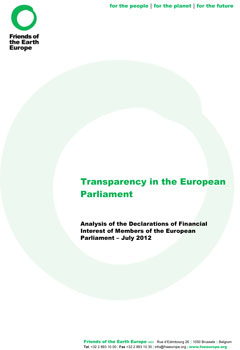
Transparency in the European Parliament

19 July 2012

In March 2011, Members of the European Parliament (MEPs) were caught red-handed accepting money for tabling amendments to legislation. What was soon to be referred to as the 'cash for amendments' or 'cash for law' scandal caused an outcry in Brussels circles.

In response, Jerzy Buzek, then President of the European Parliament, started a process to set up an ethics code for the institution, which had, until then, been missing. The 'Code of conduct for Members of the European Parliament with respect to financial interests and conflicts of interest' was agreed at the end of 2011 and entered into force on January 1st 2012.

This research reveals some of the weaknesses of the new declaration system, six months after it entered into force: the questionable accuracy of the data provided by some MEPs, and the failure of some MEPs to treat the declaration seriously.
 

    • Agriculture

      Food and farming in Europe and its global impacts

    • Agrofuels

      Plant-based fuels from agriculture. Also known as biofuels

    • Biodiversity

      Species and habitat protection in Europe and around the globe

    • GMOs

      Genetically modified crops and organisms

    • Land

      Measuring Europe’s land footprint and tackling the drivers of land grabbing

    • Biodiversity

      Species and habitat protection in Europe and around the globe

    • Extractive industries

      Oil and gas exploration, and mining

    • Land

      Measuring Europe’s land footprint and tackling the drivers of land grabbing

    • Materials and waste

      Reducing, reusing and recycling resources

    • Resource use

      Europe’s consumption of land, materials, water and carbon

    • Shale gas

      Unconventional gas and the extraction process known as ‘fracking’

    • Tar sands

      Unconventional oil. Also known as oil sands

    • Water use

      Measuring Europe’s water footprint