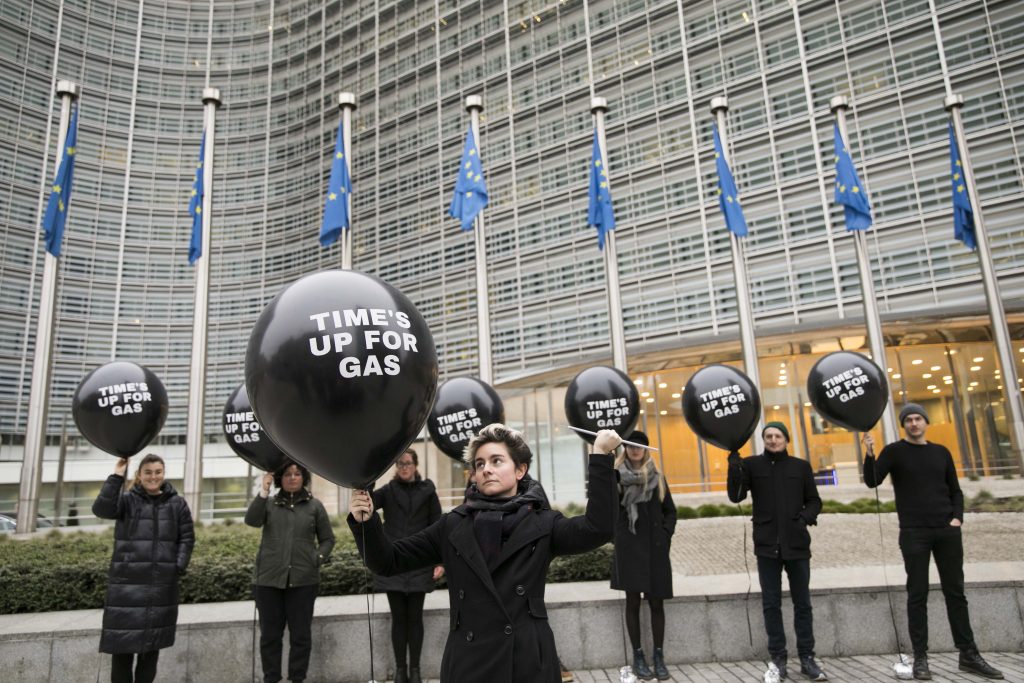

Activists satirised the Polish government’s blocking of progress on necessary climate action. Dressed as coal industry lobbyists, our activists offered free Polish coal to participants on their way to the European Council's Working Party on International Environment Issues.
Reliable sources at the European Commission's energy department paint a gloomy picture of EU climate and energy policies for 2030.
Key decisions will be taken in November. But it seems many top Commission officials just want a CO2 target or possibly a renewables target as well. As things stand now, there's not much support for a target to reduce energy consumption.
This is a serious mistake. We need all three.
This week the EU Parliament will vote on the Energy Efficiency Directive, with the Council due to follow in October. Both votes are expected to be a formality – no-one wants another row over the text.
But before savings from the Directive can actually begin in 2014, the Commission and member states must work out the exact requirements it sets. Make no mistake: this process may be just as tough as the political negotiations on the text of the Directive.
Spain ranked worst out of six countries reviewed for overall performance in the negotiations around energy efficiency, in a new ranking launched today by CAN-Europe and Friends of the Earth Europe. The ranking is based on the performance and ambition of member states negotiating the European Union's Energy Efficiency Directive. Spain ranked worst for ignoring the boost that investment in energy savings would give to its ailing economy.
Many are suggesting that it is for the EU Parliament to make concessions on the Energy Efficiency Directive dossier. This downplays the EU Council's underhand negotiating tactics, especially on the centrepiece 1.5% annual savings target.
No country could be more fitting to negotiate a deal on the draft Energy Efficiency Directive than current EU President Denmark. The country is the inspiration behind the directive – the proof that economic growth can go hand-in-hand with reductions in energy use.
But the Danes seem to have caught 'Presidency Syndrome': the desire to make a deal at all costs, to look good politically, even if this means getting an unacceptably weak directive.
Throw a frog into boiling water, the story goes, and it will jump out. But if it is placed in cold water that is slowly heated it will not perceive the danger and will be boiled to death.
This is just what is happening to the draft Energy Efficiency Directive. Each successive amendment from the European Council weakens the text a little more. Now the Council's version – a compilation of the most unambitious points from each member state – has almost reached junk status.
Friends of the Earth Europe, CAN Europe and 13 other NGOs and associations [1] are urging ministers to turn promises into action during the informal meeting of energy ministers in Horsens tomorrow (19th April). They must push for a binding 20% energy savings target, ensure a robust 1.5% annual savings obligation for energy companies, ensure deep renovation of buildings and develop national renovation roadmaps. This is the only way to ensure Europe embraces the benefits of energy savings.
On 8 April climate change minister Greg Barker told the Financial Times "We are working patiently and quietly behind the scenes with EU partners to convince them of the strong economic as well as environmental reasons why we should go for 30 per cent [greenhouse gas emission cuts] rather than 20 per cent".
Member States are rightly shunned by their peers for getting creative with budget deficit figures. So why is there so much support from national governments to apply the same methods to the EU's draft Energy Efficiency Directive?
Leaked documents from European Council meetings show that at least 12 out of 27 Member States are seeking to include 'early actions' in the Directive. If successful, they would be allowed to credit savings made before the implementation of the Directive (hence 'early action').