

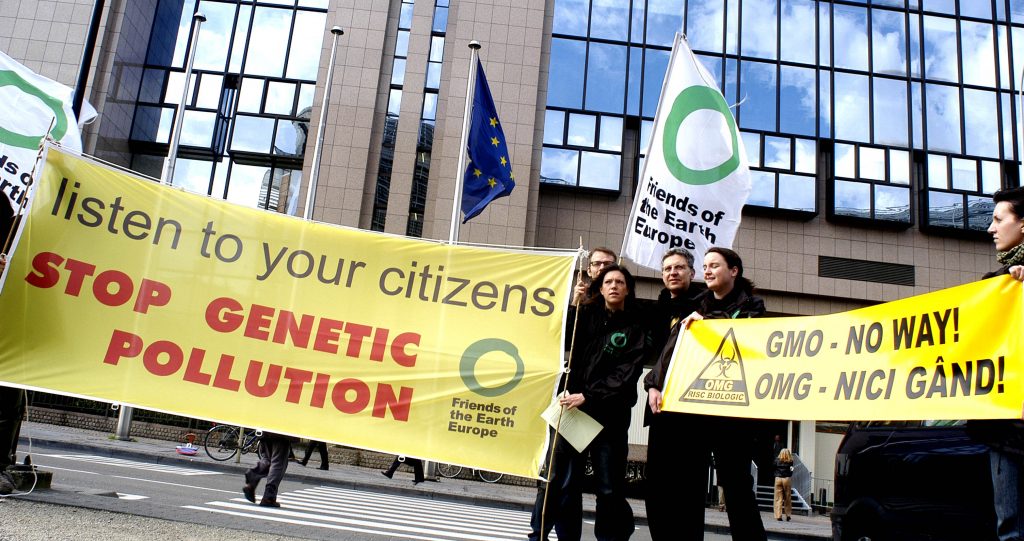
Brussels, 8 January 2007 – A new report to be released tomorrow shows that genetically modified (GM) crops have failed to address the main challenges facing farmers in most countries of the world, and more than 70 percent of large scale GM planting is still limited to two countries (U.S. and Argentina).
The new report, ‘Who Benefits from GM crops? An analysis of the global performance of genetically modified (GM) crops 1996-2006’ [1] also notes that the ‘second generation’ GM farm crops with attractive ‘traits’ long promised by the industry has failed to appear.
“No GM crop on the market today offers benefits to the consumer in terms of quality or price, and to date these crops have done nothing to alleviate hunger or poverty in Africa or elsewhere,” said Nnimmo Bassey of Friends of the Earth Africa in Nigeria.
“The great majority of GM crops cultivated today are used as high-priced animal feed to supply rich nations with meat,” he added.
According to the report, GM crops commercialised today have on the whole increased rather than decreased pesticide use, and do not yield more than conventional varieties. The environment has not benefited, and GM crops will become increasingly unsustainable over the medium to long term.
In Europe, the report acknowledges a small increase in cultivation of GM maize (up to approximately 1 percent of all maize production) but highlights strong continued opposition to GM crops in the European Union and an increase in the number of European regions declaring themselves GM Free.
Adrian Bebb of Friends of the Earth Europe said: “The widespread opposition to genetically modified crops and foods in Europe continues to restrict the growing of these unwanted and unneeded crops. Consumers and farmers can see that they offer no added value and only additional environmental and health risks.”
The Friends of the Earth International report launch coincides with the annual release of the ‘Global Status of Commercialized Biotech’ report of the industry-sponsored International Service for the Acquisition of Agri-biotech Applications (ISAAA) – which promotes GM crops as a key solution to hunger and poverty. The GM crops industry continues to misleadingly claim that GM crops play a role in solving world hunger.
2006 A BAD YEAR FOR GM CROPS
+ In 2006 the US Department of Agriculture, a chief proponent of GM
crops, for the first time acknowledged that GM crop yields are not greater than those of conventional crops, and a compelling number of studies by independent scientists demonstrate that GM crop yields are lower than, or at best equivalent to, yields from non-GM varieties.
+ In 2006 due to a soybean sector crisis and lower yields in Brazil and
Paraguay, Monsanto had to scale down its expectations in both countries.
The company was forced to publicly announce in Paraguay a reduction in the royalties they demanded from soy producers. The Ministry of Environment in Paraguay detected higher losses in Roundup Ready soy yields than in the conventional varieties, verifying that the GM varieties were highly sensitive to drought.
+ In the last decade cotton production has declined in the majority of
countries that have adopted GM cotton like Mexico, Argentina, Colombia, South Africa and Australia, and significant drops in GM cotton production specifically are forecasted in 2006 for South Africa and Mexico.
+ In 2006 a European Union-wide survey of public views reconfirmed the
European public’s opposition to GM food.
+ In 2006 the rice food supply on four continents was contaminated with
an illegal GM rice supposedly field-tested only until 2001, proving once again the inability or unwillingness of the biotech industry to control its products.
***
NOTES TO EDITORS:
[1] The executive summary of the report is available athttp://www.foei.org/publications/pdfs/gmcrops2007execsummary.pdf
The full report is available for media upon request from the contacts above or from media@foei.org
A three-page ‘Highlights of the report’ is available at: http://www.foei.org/publications/pdfs/gmcrops2007highlights.pdf