
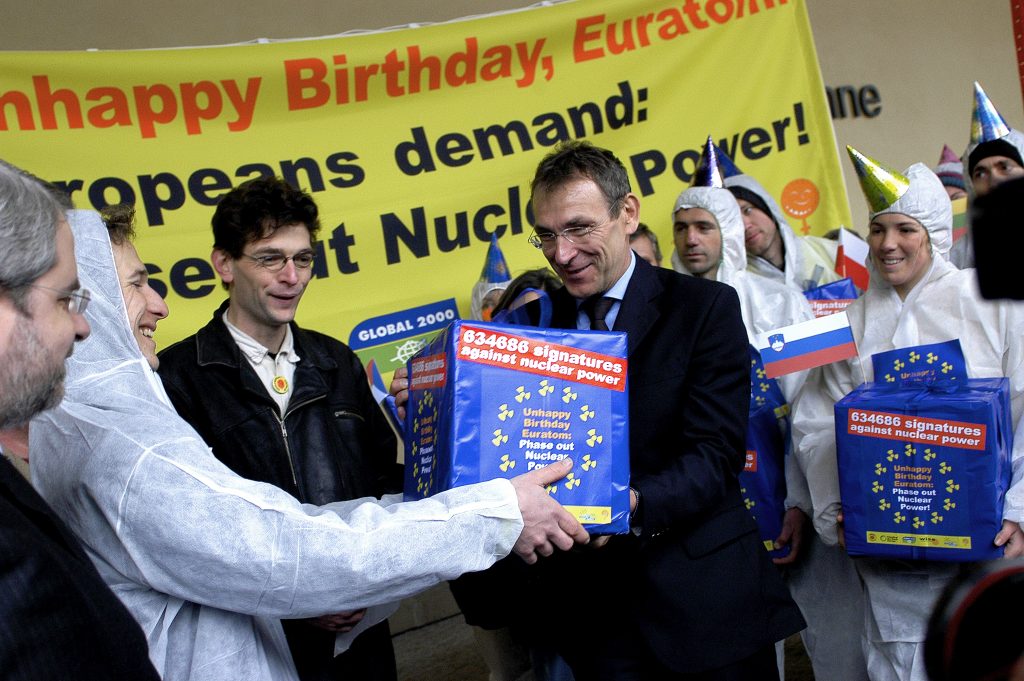
Brussels, March 23 – Ahead of the 50th anniversaries of the EU and its pro-nuclear Euratom Treaty [1], 780 organisations and 630,000 individuals have demanded abolition of Euratom and a phase-out of nuclear power across Europe. European Energy Commissioner Piebalgs received birthday presents packed with signatures today, and campaigners encouraged EU member states to consider the legally sound option of unilateral withdrawal from the nuclear treaty.
European Energy Commissioner Andris Piebalgs said, after receiving the petition:
“We have a consensus to push for renewable energy and energy efficiency and we should work for this. The number of signatures on this petition against Euratom and nuclear power is impressive. Certainly, the voices of these Europeans will be taken into consideration.”
Frank van Schaik, from the European Petition Campaign against Nuclear Power said:
“For the last fifty years, the Euratom Treaty has given unjustified and undemocratic preferential financial support to nuclear power. People across Europe have demanded that the treaty should be scrapped. And failing that, member states should exercise their sovereign right to withdraw unilaterally and halt their own contribution to this outdated nuclear fund.”
Several recent studies published by German and Austrian professors of international law conclude that it is legally possible for the EU member states to independently pull out of the Euratom Treaty, without affecting their position in the EU. [2]
The petition urges the European Commission, the European Parliament and all EU member states to:
- Stop or prevent the construction of new nuclear power plants and facilities in the European Union
- Launch a plan to abandon nuclear power within the European Union
- Invest massively in energy saving and the development of renewable energies
- End the Euratom Treaty, which massively supports nuclear power in Europe by means of public funding
The petition enforces the recent Eurobarometer poll showing that 61% of the overall EU population thinks the share of nuclear power should be decreased due to concerns such as nuclear waste and the danger of accidents.
In total, Piebalgs received 634,686 signatures from individuals and 782 signatures from organisations from all over Europe, packaged in 27 “unhappy birthday presents”. French and Belgian anti-nuclear campaigners marched from Lille through Belgium to hand over their contribution to the petition. Activists were dressed in radioactive protection suits and party hats. After receiving the presents, Piebalgs was offered a piece of ‘anti-nuclear birthday cake’.
The European Petition Campaign against Nuclear Power [3] stresses that nuclear power is still dangerous and produces a radioactive legacy of waste. Furthermore, nuclear power is not a solution to climate change – in the complete production chain of nuclear power, a considerable amount of carbon dioxide is released. In addition, as nuclear power is extortionately expensive, building new power plants is economically risky and relies on a huge injection of public money.
“An enormous amount of people in Europe don’t want nuclear power. A nuclear accident would be disastrous; radioactive waste lingers for hundreds of years; and we will save our climate much more cheaply by investing in renewables and energy efficiency instead of pouring money into extortionate nuclear power,” Mr Van Schaik concluded.
***
Notes:
[1] Euratom is one of the 3 founding treaties of the European Union from 1957.
Through Euratom, the EU gives preferential funding to nuclear power. The other founding treaties have been updated over the last 50 years, but Euratom remains unchanged since 1957.
English summary of the report:
http://www.greens-efa.org/cms/default/dokbin/172/172224.summary_denunciation_of_the_treaty_estab@en.pdf [3] The European Petition Campaign against Nuclear Power is a coalition of: atomstopp (Austria), Friends of the Earth Europe (EU/Brussels), GLOBAL 2000 (Austria), Réseau”Sortir du nucléaire” (France), WISE – World Information Service on Energy (Netherlands), Women against Nuclear Power (Finland)