
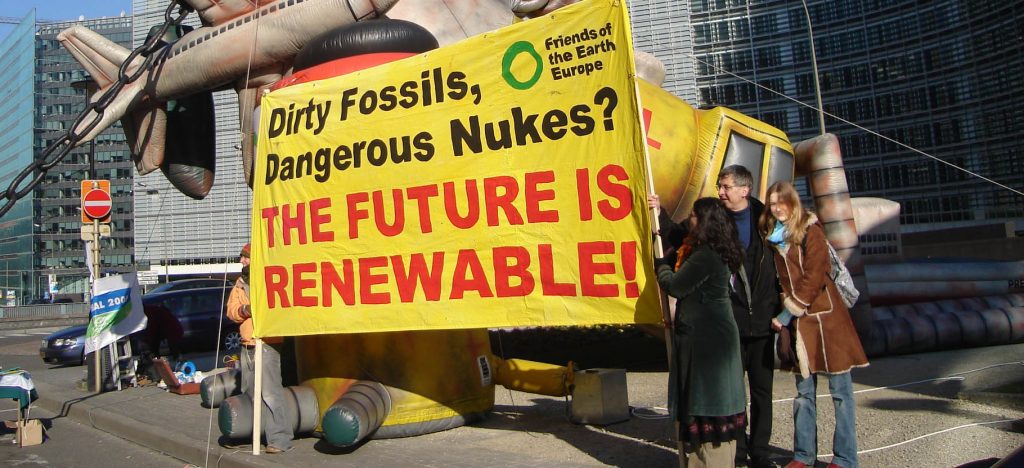
Brussels, 14 March 2006 – Friends of the Earth Europe activists today protested in front of the EU Council building, against the energy policy of the European Union by setting up a 10m high inflatable dinosaur depicting dirty energy technologies as well as an inflatable nuclear power station. A banner read: “Dirty Fossil, Dangerous Nukes? The Future Is Renewable!”. Activists distributed to officials entering the Council building edible mini power stations made from pastry. [1]
At today’s special EU Energy Council meeting, industry and economy ministers from member states agreed their view on a “New Energy Policy for Europe” that aims to secure energy supply, improve competitiveness and ensure environmental sustainability. Priority is however given to securing the long-term supply of oil and gas imports and the further integration of the European energy markets.
Jan Kowalzig, Energy campaigner at Friends of the Earth Europe in Brussels, said:
“It is unbelievable to see how ministers hold Europe in the grip of backward and dirty energy. At a time of high oil or gas prices, political instability in producer countries, the threat of climate change and rising mountains of nuclear waste, common sense dictates the EU top priority should be cutting energy waste and massively investing in renewable energies like solar and wind — this will ensure a long-term sustainable energy supply.”
Ministers failed to agree concrete targets to ensure the long-term sustainability of Europe’s energy supply. [2] While the ministers noted the need for removing “legislative and administrative obstacles to renewables take-off”, they fail to address existing market distortions and the massive perverse subsidies given to fossil and nuclear energy every year.
Friends of the Earth Europe also criticised EU policy in that nuclear energy is to receive more than half of the EU’s energy research budget. [3]
Silva Hermann, Nuclear Energy campaigner at Friends of the Earth Austria, noted:
“The nuclear energy industry operates in an artificial economic zone that was created 50 years ago. This is in contradiction to a liberalised energy market, where nuclear power simply could not survive without massive state aid.”
“Nuclear is the most dangerous form of energy. The problem of nuclear waste treatment remains unsolved, and a disaster like the one in Chernobyl 20 years ago can happen anytime anyplace. In addition, a recent Eurobarometer survey reveals that most Europeans are against nuclear power ,” she said.
Following the release of last week’s Green Paper on Energy by the EU Commission, Friends of the Earth Europe identified five major areas for action to make Europe’s energy more sustainable:
* EFFICIENCY: Europe needs a binding target to cut energy consumption by 20% by 2020, through increasing efficiency, thereby also reducing energy costs for households and industry and curbing greenhouse gas pollution.
* RENEWABLES: By 2020, Europe should meet 25% of its primary energy demand from renewable sources, making Europe less dependent from imported fossil fuels and also reducing the hidden costs of conventional power generation.
* TRANSPORT: Europe must reverse the unsustainable growth trends in the transport sector that uses up 70-80% of all oil imports into the EU and accounts for a third of Europe’s total energy use.
* NUCLEAR POWER: Phase out expensive and dangerous nuclear energy that can not survive in a liberalised energy market, especially if the high costs of decommissioning and the long-term nuclear waste storage for thousands of years are taken into account.
* SUBSIDIES: Remove perverse subsidies and other market distortions that keep dirty energy artificially cheap in comparison to its renewable competitors.
The Friends of the Earth Europe detailed briefing on the New Energy Policy for Europe is available here:
http://www.foeeurope.org/climate/download/background_NewEnergyPolicy_Council.pdf
***
NOTES
[1] High-Resolution pictures are available for free use at http://www.foeeurope.org/
[2] The agreed Council conclusions will be available from http://ue.eu.int/cms3_fo/showPage.ASP?lang=en. The draft text asks for increased research in energy technologies, an assessment of all energy options, including a debate on indigenous renewable sources and nuclear energy, securing oil and gas imports through a coherent external policy and long-term contracts with producer and transit countries as well as a diversification of pipeline routes. Under the heading “Sustainable Energy” the paper highlights the role of energy efficiency, the need for a perspective on renewable energies beyond 2010. The Council conclusions also note the need for “measurable energy efficiency improvements notably in the transport sector”. The Energy Council conclusions will feed into the debate on energy at the EU Spring Summit of Heads of States later this month.
[3] The current EU Commission proposal splits the research budget into Euro 4.8 billion for nuclear power and Euro 3 billion for all other energy technologies (the nuclear budget is for the five years 2007-11, but the proposal also contains a provisional budget for the seven year period 2007-13, adding up to Euro 4.8). The nuclear research budget runs under the Euratom treaty, beyond democratic control through the European Parliament. The money will be used to subsidise waste treatment costs of the nuclear energy companies and finance nuclear fusion research (receiving three times more than renewable energy and efficiency programmes), a technology that will not produce a single commercial kilowatt before the middle of the century – if ever.